GLOSSARY
The team at Bill Bird Shoes appreciate that many of the footwear terms used to describe the way shoes are constructed and fitted may seem quite confusing to a non-shoemaker
There can also be technical terms for an aspect of shoemaking that is used differently by other shoemakers, depending on where they are based or with whom they learned. Here are a few of the terms for the many features and processes of shoemaking that the team at Bill Bird Shoes use.
If you have any suggestions for amendments or additions, please email them to us.
A
Aglet - a plastic or metal tip on the end of a shoe lace to prevent fraying and to ease entry into the lace holes.
Ankle Boot – a type of short boot, typically with the quarters no higher than 170mm.
Ankle Shoe – a shoe with an unstiffened top line reaching just above the ankle bone.
Ankle Strap - a strap which fastens around the ankle, often through a loop on the top of the back heel-cup.
Ankle Strap Shoe – a type of shoe which fastens with an ankle strap via a loop on the top of the back heel cup.
Antique Polish - applying a polish that is darker than the colour of the underlying leather to create an appearance of age and an interesting patina.
Apron front Shoe or Boot - a shield shaped piece of leather applied to the vamp of a shoe or boot for decorative and aesthetic reasons. It can either be laid onto the surrounding leather with the stitching on the apron, or laid under the surrounding leather with the stitching on the surround. A laid-under apron ensures that there is no underlay on top of the toes of the foot.
Applied Heel - a construction of a wooden or plastic heel, which is covered on all side in the upper leather including the breast, so that the waist of the sole finishes just under the front edge.
Arch Support – area of the insole built up and strengthened to support the long arch of the foot, or a similar support which can be inserted into the shoe separately.
Awl - a pointed steel tool set in a round wooden handle used for piercing holes in leather.
B
Back Strap - a band of leather which covers and reinforces the back-seam of a shoe or boot upper.
Balmoral Boot – an ankle boot, similar to an Oxford, but with the vamp extended back around to form the quarters. It appears to be an ankle-boot leg stitched into a court shoe.
Bar Shoe – a style of shoe with a strap, called a bar, that fastens across the instep. A Mary-Jane style is an example of a Bar Shoe
Beading - a fine, folded-lengthwise leather strip that is applied along the edge of upper pieces, straps and on the top lines of shoes, giving a finished appearance to the edge. The beading is sometimes in a contrast colour to enhance the styling.
Beeswax – a soft, non-sticky yellow wax, a by-product of making honey, that is used in various ways in shoemaking. It is also the main component in high quality shoe-polish.
Bellows Tongue - a tongue made of thin water-resistant leather that is joined on both sides of the facings (lace panels) and the vamp of the shoe or boot. It folds upon itself in such a way as to provide protection from water getting into the footwear when the footwear is laced up, whilst giving enough room to allow the foot to go into the footwear when tongue is unfolded and the footwear is unlaced.
Belly Leather – heavy leather made from the belly of the animal which is tanned to enhance and strengthen the natural flexibility of the material from that part. Oak-bark tanned belly leather is used for the stiffeners and toe puffs of footwear made at Bill Bird Shoes.
Bend Leather – heavy leather made from the rear two thirds of the cow, divided down the backbone. It is tanned to enhance and toughen the natural firmness and higher density of the material from that part. Oak-bark tanned bend leather is used for the soles and heel lifts of footwear made at Bill Bird Shoes.
Blake Stitched – a sole or welt stitched directly onto the insole of the footwear by means of a Blake stitching machine.
Blind Eyelet – a metal eyelet inserted from the back of the lace-hole so it cannot be seen from the outside.
Block – (noun) a curved wooden shape on which a vamp piece is ‘blocked’ so that it takes on the shape of a particular curved shape on the instep of the foot. - (verb) the act of dampening and stretching the vamp leather onto the curved wooden block to give it the desired shape
Blücher – An open-laced shoe, similar to a Derby but with the vamp and the quarters cut in one piece and into which separate inset pieces of leather are added to form the facings.
Boot – any footwear made with the leg part extending above the ankle.
Bootie – a short light weight boot, usually for women.
Bottom – 1) the underside of the lasted-up shoe. Various processes are done to the ‘bottom’ to prepare it for the building on of the soles and heels. - 2) everything below the Upper.
Bottom Sanding - Scouring the skirt of the upper where it has been stretched under the bottom edge of the last.
Bottom Filler - material, usually cork or bituminous felt used to fill the gap on the bottom of the shoe formed by the edges of the upper where they are fastened underneath the insole. It creates a level surface for the application of the sole.
Box Calf – a very high quality black, chrome tanned, calf leather,
Breast – the front or anterior surface of the heel block of a shoe or boot.
Breasted Heels – a construction of a wooden or plastic heel, which is covered in the upper leather and onto the breast of which is extended the waist of the sole of shoe or boot.
Bristle – originally made from a boar’s bristle, modern bristles are made from a nylon monofilament about 1mm in diameter. The bristle is attached to the ends of heavy linen or hemp sewing threads with sticky wax giving a flexible yet stiff end to the thread which will follow a curved hole in the leather.
Brogue - originally a Scottish ghillie shoe with extensive patterns of holes punched into the upper, the term now refers to any shoe or boot where most of the uppers are decorated with broguing, especially an Oxford style
Broguing – an ornamentation of punching and notching on shoe or boot uppers. Broguing will be a feature on toe caps, wing caps, counters and the facings of brogued shoes and boots.
Buckle Shoe – a style of shoe with a buckle fastening.
Butcher Boot – see hunting boot.
Buttress Heel – an extension in width of a heel that extends up onto the upper to the medial or lateral side in order to compensate for a foot and ankle that has a tendency to roll in the direction the buttress is countering.
C
Calf - the best quality leather from the skin of a young bovine animal. It is strong yet supple and will last well if cared for
Cap (Toe) - a piece of leather covering the toe part of the shoe.
Cap and Counter – an upper design in which the toe-cap is matched in colour and style by a cover over the back of the heel, sometimes in contrasting colour to the rest of the upper.
Casual – any style of footwear that is less formal in appearance.
Cemented Construction – in which the rands and soles are applied to the bottom of the shoe with a heat activated contact adhesive. This produces a shoe that is relatively light, flexible and neat in appearance.
Channel – a groove around the edge of the bottom of the sole where the stitches that hold the sole onto the shoe will be protected from wear.
Cheeks - thick bovine bottoming leather used for last adaptions and heel lifts.
Chelsea Boot – an ankle boot, usually no higher that 200mm with elasticated panels on both sides of the leg and clear, undecorated vamps.
Chrome Leather - leather tanned using chrome salts which makes the leather strong, long lasting and resistant to deterioration.
Cleated Soles – a heavy duty sole unit with raised rectangles that give good grip in wet and muddy environments.
Clicking Out – using a special curve tipped knife against a cutting board to cut the leather pieces that form the upper of the footwear. the name refers to the sound made by the cutting knives.
Clog – utilitarian wooden-sole mule or closed in shoe.
Closing – the process of preparing component leather pieces and then stitched them together to form the upper of the footwear
Closer - the skilled craftsperson who prepares the upper pieces and stitches them together.
Collar - part of the shoe or boot that wraps around the ankle, it is often cushioned or padded for extra comfort, extra stability and also helps stop small pebbles from getting into the footwear.
Correspondent Shoe – an Oxford shoe with toe-caps, facings and counters in contrasting colours. The vamps and quarters are usually either white or a very light tan calf.
Counters – a rear pattern piece, at the heel of the shoe. It can be decorative, structural, or both. A lining counter is on the back part of the inside of the heel. It can be suede to help hold the shoe on if worn with tights, or smooth if worn with socks.
Coup-brevette last – a method of breaking the last into two parts for easy removal from the footwear. The break goes at a curved angle from top to bottom of the middle of the last. This is the method most used at Bill Bird Shoes. See also Scoop last.
Court Shoe – a slip-on lady’s shoe with a heel and no adjustable fastenings
Cowboy Boot - a mid-calf length, pull-on boot with side seams on the leg, raised stacked heels that are undercut at the back, pointed toes with a lot of spring, wide welts and a beveled waist. They are often highly decorated and are associated with the ‘Cowboys’ of the Mid-west United States.
Cuban Heel – a stacked leather heel, usually 35 to 50mm high, with straight, slightly tapered sides and back and straight un-tapered breast. It has a fairly wide top-piece.
D
Dainite – a British rubber sole and heel manufacturer since 1894
Deck Shoe – a shoe with a moccasin construction front with two-hole lace-panels as an extension of rolled-edge quarters with a cord running along the topline
Derby – a style of shoe where the facings sit on top of the vamp. Also called a Gibson.
Dividers – a tool used to mark out stitch holes and seam allowances equally
Dog-ear Tab – on a ‘quarter’ the dog ear is a short strip of leather on the top back of the lateral side that wraps over the top of the medial quarter. It is stitched in place as a reinforced layer at the top of the back-seam.
D’Orsay – a variation on a court shoe having the sides cut away at the waist so that the shoe is held onto the foot by the stiffener in the heel and the vamp only.
Drafting – positioning the uppers correctly on the last before hand-lasting them.
Drop – the difference in height between the heel seat and the ball of the interior surface on which the foot sits in a shoe or boot.
Dubbin – oily dressing of heavy-duty footwear designed ot keep the leather soft and flexible. It is much used by walkers and climbers.
E
Elastic-gusset Shoe – a shoe with elastic panels either side of the instep that are covered in leather that is stitched on and scored into strips that allow the elastic to function without being seen.
Elastic-on-the-instep Shoe – a slip-on style of shoe with a short strip of elastic hidden under a tab that is an extension of the vamp. It helps hold the shoe on more firmly than a simple slip-on shoe.
Elastic-sided Boot – an ankle boot with a plain vamp and matching back part, with a panel of elastic on either side of the leg and ankle. Often referred to as a Chelsea Boot.
Embossing – a method of decorating leather by pressing a heated dye onto the surface. Used by hand on shoe uppers or leather goods, or by machine on complete skins to give simulated effects and impressions.
Espadrille – a roped soled shoe with a canvas or nubuck upper.
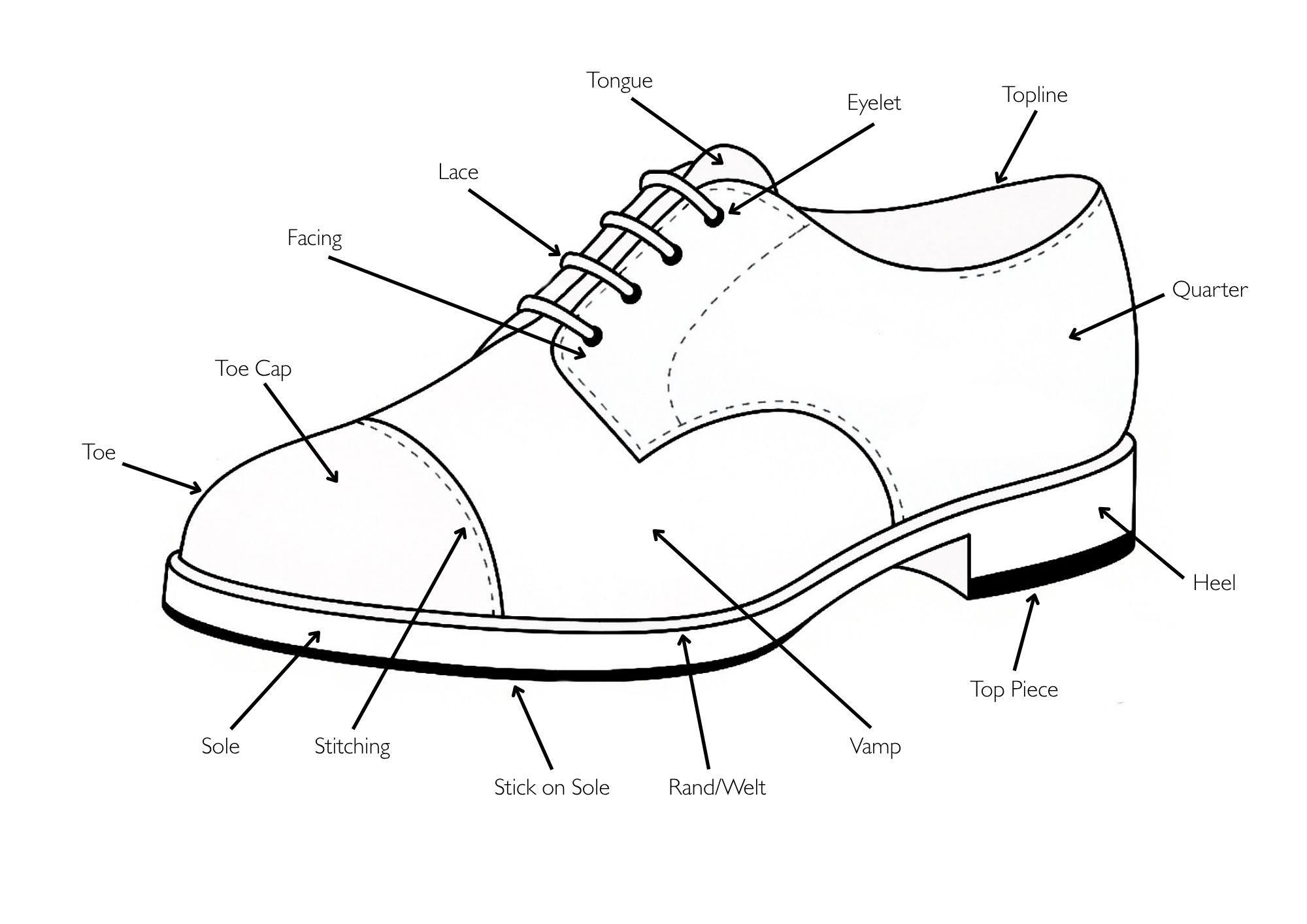
Eyelet – the round metal reinforcing of the edge of the lace-hole.
EVA – Ethylene vinyl acetate – an expanded form of synthetic rubber making it lightweight
F
Facings – the lace panels either side of the instep of a lace-up shoe (tie-shoe).
Feather – the crisp bottom edge of a last which helps the shoemaker give the shoe clean even lines. Also called the Feather-edge or the Feather-line. The Feather is one of the features where a last differs from the foot, as the foot has round edges.
Finishing – ironing and polishing the edges and bottoms of leather soled or leather-rand footwear to improve the appearance and wearability.
Fit – How the lasted upper fits around the foot.
Fit-for-purpose – a process of testing whether the makeup and functionality of a shoe or boot is capable of performing the tasks for which it was intended. i.e. a fell-boot, a dance shoe, a formal fashion shoe or an everyday shoe will have very different specifications which will be suitable for the one task but unsuitable for the others. The term does not refer to the fit of the footwear.
Fitting-stage – the stage where the upper has been lasted onto the insole and a mock up heel added to be tried on by the client as an opportunity for alterations to the shape and fit.
Fittings (Width-fittings) – a system in more expensive footwear in which the style is made in more than one width per size. Usually designated as a range from A as narrow through to E as wide.
Fittings – pieces of prepared shaped and skive bottoming leather that are cemented onto a last to alter the shape or fit. Often made in pairs to alter the left and right lasts in the same way
Flesh-side – The side of the leather that was originally on the inside of the animal.
Float – an extension in width of a heel or sole to the medial or lateral side in order to compensate for a foot and ankle that has a tendency to roll in the direction the float is countering.
Folded Edge – an edge treatment on uppers in which the edge is skived to a thin edge and then folded over so that the same finish as the leather is extended over the seen edge. Often then stitched against the lining.
Folding Knife – a tool used for folding the edge of leather.
Forepart – the front part of the shoe or sole from the waist forwards.
Forme – the initial pattern, in the flat, representing as nearly as practicable the shape of the contoured surfaces of the two sides of the last, from which the upper patterns are designed.
Foxing – thin strip of rubber attached by cement, vertically round the edge of some shoes, such as Plimsolls and Soft-lace styles.
French Chalk – talcum powder held in a shaker, for even dispersal. It stops interior of the footwear sticking to the last so that it can be easily slipped from the last when the making is done.
French binding – a method of finishing the top line of an upper by binding it with a fine strip of leather or fabric tape.
Fudge wheel – a tool with a symmetrically ridged wheel used for marking out and embossing the welt.
G
Ghillie shoe – a Scottish of shoe where the lacing passes through flat loops and there is no tongue.
Gibson – a style of shoe where the facings sit on top of the vamp. Also called a Derby.
Gimping – the delicate notched pattern sometimes cut into the edges of the leather panels for the purpose of decoration. It is a component pattern in Broguing.
Girth – the measures of the circumference of the foot and last, take at specific points during the measuring process which are then transferred onto the made-to-measure last.
Glacé kid – upper leather made from chrome-tanned kidskin, finished with a smooth glossy surface.
Grain – the visible pattern of pores and other surface peculiarities on leather, characteristic of the animal the leather comes from.
Grain leather – leather with a grain, natural or pressed, sufficiently pronounced to be used as a decorative feature.
Grecian slipper – a sipper with quarters and vamp both curving downwards to overlap on both sides near the sole, leaving a V-shape cut away appearance to the waist.
Grindery – trade name for the consumables other than the leather that go into the footwear such as rivets, adhesives and tacks.
H
Hair-side – The side of the leather that was originally on the outside of the animal.
Hand Lasting – the process in which the upper is pulled over the last and fastened onto the insole by hand using lasting pincers and rivets.
Half d’Orsay – similar to a d’Orsay with only the lateral side of the court-shoe cut out.
Half-sole – a forefoot sole-repair from the waist to the toe
Heel – component which lifts the back of the footwear away from the ground. Also, the descriptor of components to do with parts of the shoe that surround or underly the heel of the foot. (see also Breasted and Applied and Stacked heels.)
Heel Breast- the front or anterior surface of the heel block of a shoe or boot.
Heel Elevation – the height of the finished heel, measured from the feather line under the leg to the ground. In effect, the extra height that wearing the footwear adds to the height of the wearer.
Heel Height – the height of the finished heel of the footwear, measured from the back of the heel seat to the ground.
Heel Pitch – is on the last and is the distance from the back of the heel seat to the ground when there is about 6 – 8mm of toe spring on the last. (see also Pitch Elevation, also Drop, also Seat Angle.)
Heel Seat – see Seat
Hi-shine – a leather that has been treated to give it a high shine. It is not as supple as calf and will not last as well if worn heavily – Patent leather is an example.
House Shoe – a more substantial article of footwear than a slipper but with the same purpose of indoor use only.
Hunting Boot – a sturdy, robust knee length pull-on boot, usually made in black, burnished wax-calf used for hunting on horseback. According to the protocol of the Hunt, it may have mahogany or London Tan tops. A black wax-calf hunting boot without a top is known as a Butcher Boot.
I
Inking – This is the coloured or black liquid applied to edges of the sole and stacked heels of the shoe or boot. Distinct from a stain, inks give body to the edge of the leather and seals it in preparation for the final finishing.
Insole – the light weight sole, conforming to the shape of the bottom of the last, to which the upper and the bottoming are attached to make up the complete footwear. At Bill Bird Shoes, the insoles are made from best quality Oak-Bark-Tanned Shoulder and they form the backbone of the footwear. At Bill Bird Shoes, the insole will be covered with a quality leather Sock Lining and sometimes a layer of cushioning between the Sock Lining and Insole.
Instep – upper surface of the foot from just behind the origin of the toes up to where the ankle begins to bend up the shin.
Iron – Thickness of leather (48 to 1”) measured with a gauge. Approximately, 2 Irons = 1mm
J
Jodhpur Boot – short ankle boot with a plain blocked vamp overlapping a plain heel counter with a strap and side buckle fastening that wraps around the ankle.
K
Kiltie – a decorative flap on golf shoes that covers the tied-up laces.
L
Lace hole – holes in facings of tie -shoes for the laces to be threaded through.
Laces – pre-cut lengths of woven string with a metal or plastic Aglet on either end. Used to tie the footwear.
Lace panel – an alternative name for the facings, the part of the upper where the lace holes are positioned in pairs either side of the instep so that the shoe can be tightened or loosened.
Last – shaped block of wood or plastic that the shoe or boot is made on. On manufactured footwear, it gives shape and sizing to the shoes and boots. At Bill Bird Shoes, the lasts are individually made from beech-wood to the client’s unique measures and taste in style, toe-shape and heel height.
Last Slipping – Take the last out of the footwear prior to the fitting stage or prior to being prepared for delivery.
Leather – skin of a smaller animal or the hide of a larger animal that is tanned to preserve it and make into a strong material that can be used to make footwear, clothes and accessories.
Lifts – layers of strong, bottoming leather that are built up to make a stacked leather heel.
Lining – skin friendly material that makes up the inside of the upper that is against the skin or hosiery of the foot. At Bill Bird Shoes the lining is usually made from high quality, veg-tan calf leather although for some specific conditions a special diabetic lining might be sued.
loafer – a casual slip-on shoe, low cut and without an elastic on the instep. Often similar to a moccasin.
Longwing – similar to a wing-cap but the wing part cut to continue all the way around to the back of the shoe.
Long Sole – A complete sole repair from the toe to the heel
Loop (Back loop) – loop of leather at the back of the boot or shoe to help pull the boot onto the foot
Louis Heel – a shaped heel design. In Leicester is means a classic narrow breasted heel. Elsewhere it is a heel which tapers to be narrow in the middle, then flaring our on the lower half to be wide where the ‘top piece’ sits on the ground. At Bill Bird Shoes, they can be made from covered wood or made as a shaped stacked heel.
M
Moccasin – a Native North American Shoe in which the bottom leather of the shoe comes up the side, is pleated and sewn to an apron on the vamp and folded to form a heel on the back. It is often a smart casual style of shoe today the UK, being made from light leathers such as glacé kid.
Moccasin-front shoe – a simulated moccasin style with a raised lake front giving the impression of being a moccasin. This is the style we make at Bill Bird Shoes if asked to make a moccasin style.
Monk shoe – a formal men’s shoe with a strap and buckle in place of laces. A double monk has two straps and buckles.
Mule – an open backed shoe or slipper, now often called a slide. To put it on, the foot is simply slid into the front which extends to the top of the instep thereby holding the foot.
N
Nature-form shoe – a shoe with a straight inside border, low heel and adequate width for the joint and toes of the foot, designed to be as close a shape as possible to the natural foot.
Neck – the one third of a skin of upper leather furthest from the tail. It usually has too many ‘stretch-marks’ to be used for visible parts of the upper and can be used for mock-ups, sock and side-linings, and for lining quarters.
Neoprene – originally the trade name for a synthetic rubber first made in 1931. Its technical name, polychloroprene, is rarely used. This is the basis for contact cement used at Bill Bird Shoes for cemented processes.
Nubuck – a type of bovine leather which is finished by sanding the top surface, giving it a soft suede-like appearance and feel, but is much more resilient than suede.
O
Open-Toed Shoe – any shoe with vamp cut away, exposing the toe at the end
Oxford Shoe- a closed-facing, lace shoe in which the lace panels are stitched under the overlying vamp. The underlays of the facings and the need for a separate tongue can make this style difficult to make but the appearance is very formal and sleek. Oxford shoes are often brogued with wing caps and counters and broguing on the facings.
Oxford Boot – an ankle boot version of the Oxford shoe. Often brogued, it is more formal than a Derby ankle boot. It differs from a Balmoral Boot in that the vamp curves down on either side and the quarters are separate and form the sides of the leg and the facings.
P
Paris Points – system of shoe sizing common in Europe and increasingly in the UK. Also called Continental Sizes, there are three Paris Points in two centimetres so that one Paris Point is 6.7mm. The size scale starts at zero.
Pass-line – The part of a slip-on shoe or a pull-on boot which is just sufficient to allow the foot entry into the footwear whilst not being so large that the shoe or boot slips up and down when walking.
Padding - the soft cushioning material between the lining and upper of a tongue or collar that gives fullness, body and softness to protect the foot from the laces or the top line of the shoe/
Paste – a water-based adhesive used to secure the toe puff and stiffener in place within a lasted shoe. At Bill Bird Shoes we use a traditional paste that is resistant to mold and is waterproof whilst allows the foot to breathe.
Patent leather – a leather finished with a high gloss surface. At Bill Bird Shoes we use a high-quality Patent leather which, despite its expense is not the idea leather for a first time order, as it is difficult to last up and can be damaged by alterations to the lasting.
Part-made shoe - shoe still in process on the last with no sole and heel.
Patterns – the final set of shapes cut in heavy paper or card, which carries the design of the shoe. The pattern is made from the forme which in turn is taken from the contoured surface of the client’s own last. At Bill Bird Shoes, the patterns will relate to one specific style for one individual client.
Pattern cutter - the person that cuts the patterns for the shoes
Peep-toe - Open toed style of shoe, only showing one or two toes
Perforations - Patterned holes as a design feature, such as in a brogue. Originally a functional series of punched holes to allow the foot to breathe in summer footwear.
Piping – similar to Beading only with a thread laid down into the fold of the leather strip to give the beading a more rounded edge.
Pitch – is the heel height less the thickness of the sole or platform under the front of the shoe or boot. At Bill Bird Shoes, the Pitch is a feature of the made-to-measure last.
Plantar – the bottom surface of the foot. I.e. Plantar Fasciitis is a pain under the heel of the foot.
Platform – a raised and shaped block of cork, plastic or wood, usually covered in the upper leather, which raises the front of the footwear so that a much higher heel can be worn than the pitch of the last would allow. It is often used as a fashion feature but in Bespoke Orthopaedic Footwear, can be used to raise the heel height for a client with a fixed ankle.
Pleating – a gathering of the leather into small even folds for the purpose of shaping it. It is used on a moccasin for the leather coming up around the side of the shoe, and as a technique for lasting the leather around the toe or heel seat.
Printed leather – an embossed design pressed into a smooth leather to give the effect of an exotic animal such as a crocodile, or to establish more even and pronounced version of the natural surface of a leather.
Pulled over – the upper is pulled over the last after the insertion of the toe-puff and stiffener. Another word for Drafted.
Punching – see Perforations.
Punching (2 and 1) - Design of punching, usually found on broguing consisting of one large hole followed by two small holes at right angles to the line of punching. The tools used to make 2 and 1, have the one large punch and the two small punches combined into one tool.
Pump – a light, flat-heeled slip-on shoe with low cut vamps.
Polished - a leather that has been treated to give it a high shine.
Q
Quarters - The side of a shoe, extending back from the vamp at the front to the back-seam or back strap on the footwear.
Quarter Rubber top piece – a lunette of rubber, cut into the leather top piece of a heel. It is set towards the lateral side at about 30 degrees the central axis of the shoe. It aligns with where the most wear to the heel occurs for the average person. It is a high-quality feature as it gives the appearance of a leather top piece but has all the wearability of a rubber top-piece.
Quarter steel - a lunette of cast iron with fixing holes which is cut into the leather top piece of a heel. It is set towards the lateral side at about 30 degrees the central axis of the shoe. It aligns with where the most wear to the heel occurs for the average person. It is a robust feature. It gives the appearance of a leather top piece but is very durable. At Bill Bird Shoes, we advise against them as they can be dangerous when walking on steel drain covers in pavements and make a loud clicking noise when walking.
R
Rand - Strip of leather or rubber often placed around the feather-edge of the shoe, visible from the top of the shoe, it can be wide or narrow depending on the look of the footwear. Its function is to allow the sole to be wider than the upper, to make edge finishing easier and to produce a decorative effect similar to a welt.
Rasp – a metal file used for working, flattening leather. A shoemaker’s rasp is a traditional tool about 6 to 8 inches long with four surfaces. On one end is a half-round and a flat rasp on either side, the rasp being for course roughing out, and on the other end is a half-round and a flat file on either side for finer shaping prior to scrapers and sandpaper.
Riding boot – A knee-length boot used when riding horses. See also Hunting Boot. The knee-length boot designed in this way has also become a popular style for fashion footwear although the material is less robust. There is also a genre of ankle boots and Jodhpurs that are often referred to as riding boots. See also Yard Boots.
S
Sandal – a type of footwear which allows the foot to be quite open to the air. It usually has a peep-toe and a designed configuration of straps. A sandal is ideal for warmer weather.
Scoop-last – the traditional way that a last breaks into two parts for ease of removal from the shoe or boot. The scoop forms the instep of the last and once removed allows the rest of the last to be slipped from the footwear. See also Coup Brevette.
Seat – the back feather-line of the shoe where the heel of the shoe is attached and onto which the heel of the foot sits.
Semi-brogue – an Oxford shoe with broguing on a straight toe-cap and often with brogued rear counters. Can also refer to a Derby shoe, brogued in the same way.
Setting – the uppers are ‘set’ or left on the last for at least a week for the leather to fully take shape.
Shank - a reinforcing strip of steel, sole-leather, wood or plastic that reinforces under the back part of the footwear between the heel and forefoot. It prevents the shoe or boot collapsing at the waist.
Shoe – a generic term for any type of footwear that has the quarters no higher than the under side of the ankle bones of the foot.
Shoulder Leather – the leather made from the shoulders of a cow, used in the creation of the insole of the footwear. It is strong, of consistent substance and is also flexible.
Side-lining – a piece of leather that lies along the outer and inner border of the vamp between the upper and lining layers. It help sthe footwear to keep its shape and crease in the correct way
Size – a system of classifying footwear with respect to the average sizes of the feet of the population. The two system most in use in the UK are UK sizes and Euro Sizes, also called Continental sizes, French sizes or Paris Points. People get to know their foot size which helps them to choose the best fit when buying footwear.
Skiving - A tapering cut along the edge of a piece of leather, created using a sharp knife or a skiving machine. It is used so that under-lays on an upper don’t show through the overlay, so that leather edges are comfortable on the foot, and so that the edge of the leather can be folded to make a clean edge on seen parts of the upper.
Ski-Hooks – a type of lace fastening that hooks the lace so that the boot can be done up and undone without needing to pass the lace through holes. It was originally developed for Ski Boots and winter boots. At Bill Bird Shoes we have fine ski-hooks that can give the appearance of Button Boots.
Slashed elastic – also known as an elastic gusset, the leather of the upper is laid over and stitched onto elastic in vertical lines across the direction of stretch. After lasting the upper, the leather is carefully cut to allow the elastic to function.
Sling back – an open heel shoe or sandal with single strap around the hee
Slipper - a soft shoe that is not intended for outside wear.
Sock – also Sock-lining. The inserted lining for the insole, put into the footwear as part of the final preparation prior to delivery. It carries the maker’s label, and provides a finished surface for the foot to stand on. A Half-Sock sometimes referred to as a Three-quarter-sock, only covers the insole up to the tread, allowing the forefoot to walk on the natural leather insole at the front of the footwear.
Soft-lace – a style of comfort footwear originally developed by Ecco Shoes that made the Sam Smith style tennis shoe into an everyday casual walking shoe. Now copied widely it is one of the most successful of comfort shoe styles. See also zip-up shoes.
Softee – a type of calf leather that has been tumbled in a large, purpose-built heated drum. The process breaks down the fibres which make the leather stiff, without reducing the strength. Although much softer for the wearer, it will not develop a high sheen when polished.
Sole – the part of the shoe in contact with the ground
Spectator Shoe - a shoe that is made from two different materials that can vary by texture or colour.
Sprung – a process in patternmaking that allows a flat whole-cut pattern to take the contoured shape of a high-heeled last.
Stamping - the term for hot-stamping a foil logo or style number within the footwear. At Bill Bird Shoes our logo is hot foiled stamped onto our leather socks
Stiffener - Extra layer of belly leather lasted around the heel of the shoe or boot between the upper and lining. It keeps the shape in the back of the shoe as well as helping to support the foot structurally and through the gait cycle
Storm Welt - a welt where the inner edge is formed into a raised bead that presses against the upper to help repel water.
Suede – a suede is a calf or kid leather that is treated to make the reverse side of the leather the finished side instead of the hair-side.
Suede-split - a cheaper form of suede that is made by splitting one or two layers of material off of a thicker hide. This yields a split with a polishable finish and the other layers with a soft velvety surface on both sides. Although much cheaper to buy, a split is not a strong, nor as soft as a suede from a reverse-calf or reverse-kid, and so is not used at Bill Bird Shoes unless specifically asked for.
T
Tab – a small piece of leather protruding from the vamp for decorative or strengthening purposes. The term is also used for the lunette shape of the top of the vamp of a slip-on shoe that rises up the instep.
Tassel – a decorative feature on the end of a lace consisting of a fine roll of leather that has been cut into this strip at the open end.
Tasseled Loafer – a style of slip-on shoe characterized by a knotted lace in the middle of the tab with a tassel on each end.
Thomas Heel - Heel with the medial length extended under the arch to help support a flat foot. From the lateral that is the outside, the heel appears to be normal.
Throat – on a shoe, it is the central portion of the upper resting on the instep where the pass-line is. On a pull-on boot it is pass-line where the heel and ankle have to pass through the lower leg.
Toe-cap – the decorative cover applied to the toe area of the vamp.
Toe-post – the strip of leather on a sandal that rises up from the insole between the bog-toe and the second toe and connects with the straps of a toe-post sandal. It is a defining part of a ;flip-flop sandal.
Toe-spring – the space under the toe of the sole of footwear when standing on a flat surface. It should be at least 6mm for a dress shoe and is often as much as 12 or 14mm under casual footwear. The toe-spring on a last is the distance from the feather line of the toe to the flat surface the tread of the last is resting on, when the required heel height is set under the feather line of the heel-seat. The toe-spring allows for the rocking and reduced flexion of the vamp, needed for a smooth gait cycle and a vamp that does not crease excessively.
Tongue - Extension to vamp of footwear, sits up the instep of the foot and under the facings of the shoe or boot. On and Oxford shoe, it is a separate piece. The tongue helps protect the foot from the laces and from the weather.
Top-line - This is the very top edge of the shoe or boot
Top-piece - The bottom layer of the heel, it may be a particular type of grip, material or brand, the layer that is in contact with the ground. Called a top-piece even though it is on the bottom, because shoes are made upside-down.
Toe Puff – the piece of belly leather lasted over the toe between the lining and upper, to reinforce the toe, helping it to retain its shape and protect the toes inside. On cheaper shoes it will be made of a thermos-plastic which is not as strong, and does not ‘breathe.’ At Bill Bird Shoes, only the finest leather toe-puffs are used.
Trainer – a style of footwear with open facings that go right down into the vamps, cushion tongues and cushion collars, and very profiled cushioned rubber soles and wedge heels.
Two-tone - a shoe or boot that is made from two different contrast materials that can vary by texture or colour. See also Spectator and Correspondent shoes.
U
Upper - This is the name for the top part of the footwear covering the foot, this carries the style of the footwear. Every part of the Footwear above the welt or rand.
V
Vamp - the front part of the upper that covers the toes. In a simple shoe, there are the quarters on either side of the rearfoot and the vamp over the front of the foot.
Vegetable-tanned – leather that has been tanned with traditional tanning agents, oils and waxes such as derived from Birch, Catechu, Chestnut, Mimosa, Oak, Sumac and Willow. Veg-tanned leather is more susceptible to deterioration but if well cared for can develop a beautiful patina, is much kinder to the skin and to the environment. At Bill Bird Shoes, all of our lining leather is a vegetable-tanned
Velcro – a means of fastening two surfaces together quickly and easily. The name is a shortening of Velure and Crochet, meaning a soft fabric pile on one side which is grabbed by fine hooks on the other side. Velcro fastenings are now very common in children’s shoes in place of laces. At Bill Bird Shoes, Velco fastenings are most often used for people who have arthritis in their hands and for people who cannot reach down to fasten their shoes and have to use an extension tool.
Veldschoen – a specialised welting process where the upper is turned out from the shoe and a narrow welt is laid on top to reinforce the out-turned upper. It is a style from Scandinavia and norther Germany as is designed to repel water.
Veldt – a specialised process where the upper is turned out from the shoe and is used as the welt. There is no additional welt laid on top as in a Veldschoen.
W
Waist – the part of the sole of the shoe that is between the forepart and the heel of the footwear. At Bill Bird Shoes, the waist us either square edged or beveled edged.
Walking Boot – a type of boot that is designed to be robust, water-proof and capable of giving a good grip on un-paved surfaces.
Walking Shoe – often less robust than a walking boot, it is a casual shoe that is capable of walking longer distances and on rough ground, often used by dog-walkers.
Wedge Angle – the angle that the seat of a high heeled shoe makes with the ground.
Wedge Heels - a type of sole style that is full from the joint of the foot back, it’s a supportive alternative to a separate heel. Often seen on trainer shoes, espadrilles and many sandals.
Welt – often called the ‘backbone’ of the shoe or boot, the welt is a strip of high quality shoulder leather that is sewn through the upper into a rib on the insole. The welt binds the upper strongly onto the insole and at the same time projects out from the side of the shoe at the feather line. This enables the welt to be stitched onto the sole, thereby creating a very strong and flexible construction method. The welt and stitches are visible on the outside of the shoe and contributes to the elegance and appearance of the footwear.
Weight – the thickness of leather soles. It used to be measured in irons which were 1/48th of an inch. At Bill Bird Shoes, the weight is measured in millimetres.
Wellington Boot – a mid-calf pull-on boot with a whole-cut vamp and tab at the top of the instep and legs formed from a front and a back piece, stitched up either side with a fine welt that continues down to join the whole-cut heel piece to the side of the vamp. Now more commonly seen as a style of rubber boot, affectionally known as Rubber Wellies.
Wing-tip – also wing-cap is the shape of the toe -ap on a full brogue that starts at the toe and reaches around the sides. An Austrian wing-cap does not extend as far back as a full wing-cap.
Wing cap – see Wing-tip
Whole cut - an upper cut from one piece of leather and only seamed up the back quarters.
X
Z-ray Fluoroscope – installed in shoe stores from the 1920s to the 1970s, the device was a metal construction covered in finished wood, about 1.2 metres high. The customer, often a child, could place their feet whilst wearing the shoe being tried on and they could see the bones of their feet, inside the outline of the shoe. They could check for wriggle room in the toes and whether there was excess pressure of too much room. They were withdrawn in the 1970s due to health concerns over the amount of radiation the customers and the sales staff were being exposed to. At Bill Bird shoes we use traditional forms of measurement for making our made-to-measure footwear.
Y
Yard Boots – a robust knee-length or mid-calf-length riding boot, usually with a zip up the back, used for mucking out stables whilst also being ideal for casual riding and exercising horses.
Z
Zig zag - The type of criss-cross stitch used for stitching a back-seam together without an overlap. It is not usually a seen stich and should be covered with a back strap.
Zippers – originally a fastening where metal teeth are attached to two strips of fabric tape stitched onto either side of an opening. A slider is pulled up so that the teeth engage on both sides, and the slider is pulled down to undo the opening. At Bill Bird Shoes we use modern nylon/steel coil zips which are light, strong and easy to run as well as coming in dark colours.
Zip Guard – a strip of lining leather that extends out from one side of a zip opening to protect the skin from abrasion then the slider is pulled up or down.
Zip-up-the-back Boots – these can be ankle boots, mid-calf boots or knee-length boots where a zip that runs from the top of the back of the leg down to the heel seat. This design achieves a snug fit around the ankle and is easy to get on, even with a fixed ankle or rigid toe. The disadvantage is that the stiffener is cut in half and is therefore less supportive. At Bill Bird Shoes this style is used for people with ankle injuries and fragile skin.
Zip-up-the-inside Boots - these can be ankle boots, mid-calf boots or knee-length boots where a zip that runs from the top down the medial side to the arch is undone to allow the foot to gain entry. When the zip is done up, the ankle area of the boot is narrower than a pull-on boot, but is still wider than the ankle of the leg.
Zip-up Shoes – these are a style that has become very popular since 2023. The zip runs parallel to the facings of a Soft-lace shoe so that the laces only need to be adjusted once and then the shoe put on and off by undoing the zip.